
Genesis 49:8–12 — When the Blessing Moves to Yehudah
The Big Idea
Last night we kept working through Jacob's deathbed poem, and we landed on the lines that change everything: the blessing that once rested on Yaakov, then seemed to land on Yoseph, now gets spoken over Yehudah. If you've been with us through this whole Joseph series, you know that's not a small detail. It's the hinge the whole story has been swinging toward.
We've said it before, and it's worth saying again — this book is all about tying these hyperlinks together. We like to read these stories as separate stories, but they're not. Genesis is one long argument, and chapter 49 is where a lot of those threads get pulled tight.
We've said it before, and it's worth saying again — this book is all about tying these hyperlinks together. We like to read these stories as separate stories, but they're not. Genesis is one long argument, and chapter 49 is where a lot of those threads get pulled tight.
Key Takeaways
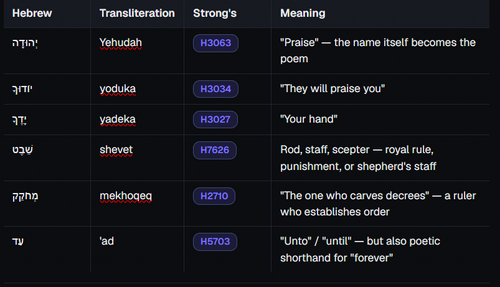
1. The name itself is the poem. Look at the Hebrew: Yehudah (H3063), yoduka — "they will praise you," and yadeka — "your hand." All those letters match up. Jacob isn't just pronouncing a blessing here; he's playing with the sound of his son's name. That's what poetry does. It takes a name and makes it mean something.
2. Yehudah gets the language that used to belong to Yoseph. Here's the part that makes you sit up. Jacob says to Yehudah, "Your father's sons will bow down to you." Wait a minute — that was the dream. That was Yoseph's dream back in Genesis 37. The brothers said, "Will we really bow down to you? Will you rule as king over us?" And Yoseph did rule. The narrative went out of its way to show them bowing (Genesis 42:6).
But now that language gets transferred to Yehudah. And the reason matters: Yoseph is the one who makes salvation available to the family, but Yehudah is the one who turns the tide. Remember the center of the center of the center of the Joseph story? It's the pivot where Yehudah offers his own life in the place of his brother. That's the moment. The moment he made himself a servant is the moment he becomes exalted as king over the brothers.
3. This is typology, and it's reading forward, not backward. We talked about the word typology, and it's had an interesting history in how different Christian groups read the Bible. Sailhamer calls it a picture or an image. Emadi calls it a prefiguration, a type, a pattern.
Here's the distinction I want you to hold onto. There's a way of reading that says, "Now that Jesus has arrived, we have the interpretive key, so let's go back and fit Jesus onto the types." That's reading backward. What I've been trying to show you is different — it's reading forward. If you just trace the patterns, the argument of Genesis itself is pointing ahead. Whoever put this scroll together, pre-Jesus, wants us to see the Yoseph story as a pattern that a future seed of Yehudah will fulfill.
So yes, it's prophecy. But it's not prediction-and-fulfillment the way we usually mean it. The narrative itself is the prediction. That's what the word "type" actually means — a pattern that gives you forward momentum.
4. David is a new Yoseph. Once you see it, you can't unsee it. When you get to the scroll of Samuel, the life of David is patterned all over the life of Yoseph — not Yehudah, Yoseph.
5. Two Hebrew words carry the whole promise. The scepter is shevet (H7626) — a wooden staff, the thing a king holds. It can mean a royal rod of rule, a rod of punishment, or a shepherd's staff. Because "shepherd" is a common biblical metaphor for "king," those meanings all bleed into each other.
The ruler's staff is mekhoqeq (H2710) — literally "the one who carves decrees." A king would carve his decrees into tablets and display them at the palace. So to be the carver is to be the ruler who brings order by making just decrees. And notice — Yehudah is the one who taught his family how to go down to Egypt. He was the instructor.
6. That little word 'ad is doing more work than you'd think. Most of our English translations read verse 10 as, "The scepter will not depart from Yehudah until he comes." And the way "until" functions in English, it sounds like Yehudah holds the rule for a while and then hands it off.
But the Hebrew is 'ad ki — literally "unto because." It's not common, and none of its other occurrences are in poetry. And poetry tends to use adapted forms of language all the time.
Here's the other thing: 'ad can also function as a poetic shorthand for "forever." Every ancient Jewish interpretation we know of takes it that way. So instead of "until," you get, "The scepter will not depart from Yehudah ever." Very different meaning.
Richard Steiner makes the case that the line actually carries both meanings on purpose. The rod of God's punishing justice will not depart from Yehudah — and the rod of royal rule will not depart from Yehudah. Both are eternal.
7. Nathan picks up both meanings in 2 Samuel 7. Read that chapter with Genesis 49:10 in your ear and it's everywhere. God promises David a seed, a kingdom, a throne established 'ad 'olam — unto forever. And then: "When he commits iniquity, I will correct him with a shevet of men, with strokes of the sons of humanity." Other human kingdoms become the rod God uses to punish.
So the question the whole story is asking is this: which one wins? The promise of redemption, or the judgment on human evil? And in a way, that's the center of the whole thing, isn't it? God's purpose to elevate humans as a royal image of God, set against human stubbornness and willfulness and sin.
One of them has to give. And what Genesis 49:10 represents — and what the cross represents — is the moment where the blesser and the giver of royal power subjects himself to his own judgment.
8. The lion is the lamb. "Lion of Judah" comes from exactly one place in the New Testament: Revelation 5:5, in the throne room, when nobody can open the scroll that holds God's plan for the world. John hears, "the Lion from the tribe of Judah, the Root of David, has overcome." Then he looks — and sees a lamb standing, as if slain.
What he hears is Genesis 49 and Isaiah 11. What he sees is the crucified Jesus of Nazareth. That contrast is the whole point. The way Messiah gained victory over his enemies was to do what Yehudah did — give his life for others. His losing is his victory. The militaristic imagery of Revelation gets re-tuned to the language of the four Gospels: a crown of thorns, a robe over a bloody back.
You have to hold both. The moment you lose one, you get a distorted Messiah.
2. Yehudah gets the language that used to belong to Yoseph. Here's the part that makes you sit up. Jacob says to Yehudah, "Your father's sons will bow down to you." Wait a minute — that was the dream. That was Yoseph's dream back in Genesis 37. The brothers said, "Will we really bow down to you? Will you rule as king over us?" And Yoseph did rule. The narrative went out of its way to show them bowing (Genesis 42:6).
But now that language gets transferred to Yehudah. And the reason matters: Yoseph is the one who makes salvation available to the family, but Yehudah is the one who turns the tide. Remember the center of the center of the center of the Joseph story? It's the pivot where Yehudah offers his own life in the place of his brother. That's the moment. The moment he made himself a servant is the moment he becomes exalted as king over the brothers.
3. This is typology, and it's reading forward, not backward. We talked about the word typology, and it's had an interesting history in how different Christian groups read the Bible. Sailhamer calls it a picture or an image. Emadi calls it a prefiguration, a type, a pattern.
Here's the distinction I want you to hold onto. There's a way of reading that says, "Now that Jesus has arrived, we have the interpretive key, so let's go back and fit Jesus onto the types." That's reading backward. What I've been trying to show you is different — it's reading forward. If you just trace the patterns, the argument of Genesis itself is pointing ahead. Whoever put this scroll together, pre-Jesus, wants us to see the Yoseph story as a pattern that a future seed of Yehudah will fulfill.
So yes, it's prophecy. But it's not prediction-and-fulfillment the way we usually mean it. The narrative itself is the prediction. That's what the word "type" actually means — a pattern that gives you forward momentum.
4. David is a new Yoseph. Once you see it, you can't unsee it. When you get to the scroll of Samuel, the life of David is patterned all over the life of Yoseph — not Yehudah, Yoseph.
- Both are shepherds (1 Samuel 16:11, 19 // Genesis 37:2)
- Both are selected over their brothers for royal rule (1 Samuel 16:6–13 // Genesis 37:5–11)
- Both are sent by their fathers to check on the shalom of their brothers, and in both stories the brothers are hostile (1 Samuel 17:17–18 // Genesis 37:13–14, 18–28)
- Both are endowed with "understanding" by the Spirit of God (Genesis 41:33, 38 // 1 Samuel 16:13, 18)
- "And Yahweh was with him" — that line shows up in both stories (Genesis 39:2, 21 // 1 Samuel 16:18; 17:37)
- Jonathan, son of Binyamin, brother of Yoseph, loves David of Yehudah, and his life is bound to David's life (1 Samuel 18:1) — and that's exactly the language Yehudah uses about Binyamin in Genesis 44:30
5. Two Hebrew words carry the whole promise. The scepter is shevet (H7626) — a wooden staff, the thing a king holds. It can mean a royal rod of rule, a rod of punishment, or a shepherd's staff. Because "shepherd" is a common biblical metaphor for "king," those meanings all bleed into each other.
The ruler's staff is mekhoqeq (H2710) — literally "the one who carves decrees." A king would carve his decrees into tablets and display them at the palace. So to be the carver is to be the ruler who brings order by making just decrees. And notice — Yehudah is the one who taught his family how to go down to Egypt. He was the instructor.
6. That little word 'ad is doing more work than you'd think. Most of our English translations read verse 10 as, "The scepter will not depart from Yehudah until he comes." And the way "until" functions in English, it sounds like Yehudah holds the rule for a while and then hands it off.
But the Hebrew is 'ad ki — literally "unto because." It's not common, and none of its other occurrences are in poetry. And poetry tends to use adapted forms of language all the time.
Here's the other thing: 'ad can also function as a poetic shorthand for "forever." Every ancient Jewish interpretation we know of takes it that way. So instead of "until," you get, "The scepter will not depart from Yehudah ever." Very different meaning.
Richard Steiner makes the case that the line actually carries both meanings on purpose. The rod of God's punishing justice will not depart from Yehudah — and the rod of royal rule will not depart from Yehudah. Both are eternal.
7. Nathan picks up both meanings in 2 Samuel 7. Read that chapter with Genesis 49:10 in your ear and it's everywhere. God promises David a seed, a kingdom, a throne established 'ad 'olam — unto forever. And then: "When he commits iniquity, I will correct him with a shevet of men, with strokes of the sons of humanity." Other human kingdoms become the rod God uses to punish.
So the question the whole story is asking is this: which one wins? The promise of redemption, or the judgment on human evil? And in a way, that's the center of the whole thing, isn't it? God's purpose to elevate humans as a royal image of God, set against human stubbornness and willfulness and sin.
One of them has to give. And what Genesis 49:10 represents — and what the cross represents — is the moment where the blesser and the giver of royal power subjects himself to his own judgment.
8. The lion is the lamb. "Lion of Judah" comes from exactly one place in the New Testament: Revelation 5:5, in the throne room, when nobody can open the scroll that holds God's plan for the world. John hears, "the Lion from the tribe of Judah, the Root of David, has overcome." Then he looks — and sees a lamb standing, as if slain.
What he hears is Genesis 49 and Isaiah 11. What he sees is the crucified Jesus of Nazareth. That contrast is the whole point. The way Messiah gained victory over his enemies was to do what Yehudah did — give his life for others. His losing is his victory. The militaristic imagery of Revelation gets re-tuned to the language of the four Gospels: a crown of thorns, a robe over a bloody back.
You have to hold both. The moment you lose one, you get a distorted Messiah.
Helpful Hebrew Words
Discussion Questions
- Jacob transfers Yoseph's dream language onto Yehudah. Why do you think the story does that? What does it tell us about how God's promises move through a family, and not always the way we'd expect?
- We said Yoseph makes salvation available but Yehudah turns the tide by offering his life. Where do you see that pattern in your own life — someone whose sacrifice changed the direction of things?
- The idea of "reading forward" instead of "reading backward" is a big shift. How does it change the way you read the Old Testament when you look for patterns pointing ahead rather than hunting for predictions to match?
- Steiner argues the word 'ad carries both "until" and "forever" at the same time — the punishing rod and the royal rod, both eternal. How does holding both of those together shape the way you understand the cross?
- Revelation 5 gives us a lion we hear and a lamb we see. Why does that contrast matter for how we understand power, victory, and what it means to follow Jesus?
- Yehudah's exaltation came after he offered himself as a servant. What would it look like this week to trust that pattern — that the way down is the way up?
This Week
Read Genesis 49:8–12 slowly, out loud, a few times. Then read Revelation 5:2–6 right after it. Sit with the contrast between what John hears and what John sees.
And ask yourself the question the passage is really asking: Do I trust the lion, or do I trust the lamb? Because the answer changes how you handle everything — your enemies, your failures, your family, your future.
Next week we keep moving through Jacob's poem of blessing. Come ready.
And ask yourself the question the passage is really asking: Do I trust the lion, or do I trust the lamb? Because the answer changes how you handle everything — your enemies, your failures, your family, your future.
Next week we keep moving through Jacob's poem of blessing. Come ready.