
Genesis 49:13–28
If you missed Wednesday night, you missed a good one. We finished out Jacob's poem of blessing — the last eight sons, all of them short, all of them packed. And if you were there, this is your chance to go back through it and let some of it settle.
Because here's what I keep saying about these chapters: too often we read these stories as separate stories. They're not. This book is tying hyperlinks together, and Genesis 49 is one of the tightest knots in the whole thing.
Because here's what I keep saying about these chapters: too often we read these stories as separate stories. They're not. This book is tying hyperlinks together, and Genesis 49 is one of the tightest knots in the whole thing.
Where We Are
Jacob is at the end of his life. He's gathered his twelve sons, and what comes out of his mouth is poetry — not a will and testament in the legal sense, but prophetic poetry. A lot of these lines are coded allusions to things that go down later in Joshua, Judges, and Samuel. Where the tribes settle. What happens to them there. And they all match up in ways that should make you sit up straight.
We covered the first four sons of Leah last time. Eight more to go. Let's walk back through them.
We covered the first four sons of Leah last time. Eight more to go. Let's walk back through them.
Zevulun (v. 13)
"Zebulun will live by the seashore and will be a harbor for ships, and his territory will be next to Sidon."
Zevulun's the puzzle. Because look at the map of the tribal allotments in Joshua — he's inland. He's landlocked. He's near the coast, sure, maybe ten or fifteen miles, an afternoon jog. But he's not on it.
And yet the Zevulunites are linked to the sea in Moses' blessing too. So what do we do with that? Some folks think it's about trade and commerce — the only Mediterranean ports Israel ever operated out of were in that northern region. Jacob's blessing is capturing Zevulun's functional relationship to maritime prosperity, not precise coastline ownership. And honestly, that distinction matters more theologically than it does geographically.
I'll be straight with you: I haven't found an answer that fully satisfies me on this one. I'll keep looking.
Zevulun's the puzzle. Because look at the map of the tribal allotments in Joshua — he's inland. He's landlocked. He's near the coast, sure, maybe ten or fifteen miles, an afternoon jog. But he's not on it.
And yet the Zevulunites are linked to the sea in Moses' blessing too. So what do we do with that? Some folks think it's about trade and commerce — the only Mediterranean ports Israel ever operated out of were in that northern region. Jacob's blessing is capturing Zevulun's functional relationship to maritime prosperity, not precise coastline ownership. And honestly, that distinction matters more theologically than it does geographically.
I'll be straight with you: I haven't found an answer that fully satisfies me on this one. I'll keep looking.
Yissakhar (vv. 14–15)
"Issachar is a strong donkey lying down between the saddlebags. He saw that his resting place was good and that the land was pleasant, so he leaned his shoulder to bear a load and became a forced laborer."
Somebody who's strong. Somebody who sees what is good. And then ends up not attaining the blessing.
I know that storyline.
Yissakhar settles right next to Zevulun, further inland. And in Judges 1, Yissakhar is among the tribes that cannot drive out the Canaanites living in their area. So this is a story of going into the land, having every capability of achieving an Eden, and then becoming subservient to whoever else was already there.
That little phrase "forced labor" is doing real work. Because other tribes do overcome the Canaanites and subject them to forced labor. But here, it's reversed. The tribe becomes the forced laborer.
He saw the good land. He bowed his shoulder anyway.
Somebody who's strong. Somebody who sees what is good. And then ends up not attaining the blessing.
I know that storyline.
Yissakhar settles right next to Zevulun, further inland. And in Judges 1, Yissakhar is among the tribes that cannot drive out the Canaanites living in their area. So this is a story of going into the land, having every capability of achieving an Eden, and then becoming subservient to whoever else was already there.
That little phrase "forced labor" is doing real work. Because other tribes do overcome the Canaanites and subject them to forced labor. But here, it's reversed. The tribe becomes the forced laborer.
He saw the good land. He bowed his shoulder anyway.
Dan (vv. 16–18)
"Dan will judge his people as one of the tribes of Israel. Dan will be a snake by the road, a viper beside the path, that bites the horse's heels so that its rider falls backward. I wait for your salvation, Lord."
There's a wordplay here that English just can't carry. Dan (דָּן) is the verb — it means to judge, to bring justice. So: "Dan, he will yadin his people." Not judge in our English sense of condemn, but rule and lead with justice and wisdom.
And then the line that makes you stop. Is it a blessing or a curse? A snake on the path, a viper that bites the horse's heel so the rider falls backward.
That's Genesis 3:15 language. Biting the heel.
There's a wordplay here that English just can't carry. Dan (דָּן) is the verb — it means to judge, to bring justice. So: "Dan, he will yadin his people." Not judge in our English sense of condemn, but rule and lead with justice and wisdom.
And then the line that makes you stop. Is it a blessing or a curse? A snake on the path, a viper that bites the horse's heel so the rider falls backward.
That's Genesis 3:15 language. Biting the heel.
The Translation Question
The Hebrew phrase is יְהִי דָן נָחָשׁ — and there are two legitimate ways to render it, because Dan is both a name and a verb.
Option 1:
16 Dan, he will judge his people as one of the tribes of Israel. 17 May there be a judge of the snake on the path, a viper along the way, which bites the heels of the horse so that its rider falls backward.
Option 2:
16 Dan, he will judge his people as one of the tribes of Israel. 17 May Dan be a snake on the path, a viper along the way, which bites the heels of the horse so that its rider falls backward.
Option 1 anticipates a future Danite who will judge the snake. Option 2 portrays Dan as the snake. The allusion to Genesis 3:15 is intentional either way — especially because the next word, "viper" (שְׁפִיפוֹן, shephiphon), carries the same consonants as the key word for "strike" in Genesis 3:15 (שׁוּף, shuph).
Option 1:
16 Dan, he will judge his people as one of the tribes of Israel. 17 May there be a judge of the snake on the path, a viper along the way, which bites the heels of the horse so that its rider falls backward.
Option 2:
16 Dan, he will judge his people as one of the tribes of Israel. 17 May Dan be a snake on the path, a viper along the way, which bites the heels of the horse so that its rider falls backward.
Option 1 anticipates a future Danite who will judge the snake. Option 2 portrays Dan as the snake. The allusion to Genesis 3:15 is intentional either way — especially because the next word, "viper" (שְׁפִיפוֹן, shephiphon), carries the same consonants as the key word for "strike" in Genesis 3:15 (שׁוּף, shuph).
What Actually Happened to Dan
Dan never settled in their allotted territory (Joshua 19:47) because of Canaanite hostility. So they migrated north of Galilee and settled there. They never held permanent land. They were a small but tenacious tribe.
And that migration story is connected to some of the worst material in the book of Judges. The Danites can't overcome the Canaanites where they're supposed to land, so they go north and slaughter a peaceful city — just like Simeon and Levi did to the Canaanites. And then Dan becomes the center of an idolatrous shrine, with a man set up as priest who had no business being up there. All of that is the end of Judges.
And that migration story is connected to some of the worst material in the book of Judges. The Danites can't overcome the Canaanites where they're supposed to land, so they go north and slaughter a peaceful city — just like Simeon and Levi did to the Canaanites. And then Dan becomes the center of an idolatrous shrine, with a man set up as priest who had no business being up there. All of that is the end of Judges.
Samson
This tribe produced one important hero, and his story is cryptically anticipated right here: Samson, in Judges 13–16. Samson was a Danite. And his entire story depicts him as a deceiver who gets deceived unto his own destruction — an anti-Genesis-3:15 figure. A wounded victor. Deceived by his wife, suffering because of his own sins.
The whole Samson narrative develops the "seed of the woman versus the snake" pattern from Genesis 3:15–16, and it's anticipated here in riddle form.
The whole Samson narrative develops the "seed of the woman versus the snake" pattern from Genesis 3:15–16, and it's anticipated here in riddle form.
How Early Jewish Readers Heard It
The Targum Neofiti reads verse 17 as Samson directly:
"This shall be the redeemer who is to arise from the house of Dan; he will be strong, exalted above all nations. He will be compared to the serpent that lies on the ground, and to a venomous serpent that lies in wait at the crossroads... He is Samson bar Manoah, the dread of whom is upon his enemies... He goes out to war against those that hate him and kills kings together with rulers."
And then Jacob answers in verse 18:
"Our father Jacob said: 'Not to the redemption of Gideon bar Joash does my soul look, which is the redemption of an hour; and not to the redemption of Samson bar Manoah does my soul look, which is a transient redemption. Rather to the redemption of him does my soul look that you have said to bring your people, the house of Israel. To you, to your redemption, do I look, O Lord.'"
Louis Ginzberg preserves a similar tradition in Legends of the Jews: Jacob believed the heroic man to be the Messiah, but when Samson's death was revealed to him, he exclaimed, "I wait for Thy salvation, O Lord, for Thy help is unto all eternity, while Samson's help is only for a time."
The Triad
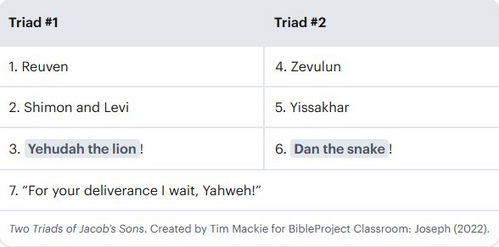
If we separate out that cry for deliverance — "I wait for your salvation, Lord" — it forms an interesting triad, almost like the seven days of creation form a structure. Brothers opposed to each other. Yehudah the lion and Dan the snake, with the cry for deliverance standing between them.
"This shall be the redeemer who is to arise from the house of Dan; he will be strong, exalted above all nations. He will be compared to the serpent that lies on the ground, and to a venomous serpent that lies in wait at the crossroads... He is Samson bar Manoah, the dread of whom is upon his enemies... He goes out to war against those that hate him and kills kings together with rulers."
And then Jacob answers in verse 18:
"Our father Jacob said: 'Not to the redemption of Gideon bar Joash does my soul look, which is the redemption of an hour; and not to the redemption of Samson bar Manoah does my soul look, which is a transient redemption. Rather to the redemption of him does my soul look that you have said to bring your people, the house of Israel. To you, to your redemption, do I look, O Lord.'"
Louis Ginzberg preserves a similar tradition in Legends of the Jews: Jacob believed the heroic man to be the Messiah, but when Samson's death was revealed to him, he exclaimed, "I wait for Thy salvation, O Lord, for Thy help is unto all eternity, while Samson's help is only for a time."
The Triad
If we separate out that cry for deliverance — "I wait for your salvation, Lord" — it forms an interesting triad, almost like the seven days of creation form a structure. Brothers opposed to each other. Yehudah the lion and Dan the snake, with the cry for deliverance standing between them.
Gad (v. 19)
"Gad will be attacked by raiders, but he will attack their heels."
In Hebrew it's גָּד גְּדוּד יְגוּדֶנּוּ — Gad gedud yegudennu. A three-word wordplay. "Gad" is spelled with the same letters as the word for a troop of soldiers. And when a troop does its trooping — that's raiding, that's attacking.
"Gad, a troop will troop him. And he will troop at the heel."
So notice: Genesis 3:15 echoes on both sides of the cry for deliverance. Man, I wish we had an actual snake crusher around here. Wouldn't that be great? Will it come from Dan? Yeah, kind of, but not. Will it come from Gad? Yeah, no, not really.
In Hebrew it's גָּד גְּדוּד יְגוּדֶנּוּ — Gad gedud yegudennu. A three-word wordplay. "Gad" is spelled with the same letters as the word for a troop of soldiers. And when a troop does its trooping — that's raiding, that's attacking.
"Gad, a troop will troop him. And he will troop at the heel."
So notice: Genesis 3:15 echoes on both sides of the cry for deliverance. Man, I wish we had an actual snake crusher around here. Wouldn't that be great? Will it come from Dan? Yeah, kind of, but not. Will it come from Gad? Yeah, no, not really.
Asher (v. 20)
"Asher's food will be rich, and he will produce royal delicacies."
"Asher, rich is his bread. He will give עֵדֶן (eden) to the king." That's the noun eden. Delicacies, but the word underneath is Eden.
And "Asher" (אָשֵׁר) is one of the Hebrew words for blessing. So from the blessed one comes rich bread — Eden for the king.
Asher settles right above where Zevulun is on the coast. And so it invokes this promise that Asher could become a source of blessing for the king.
Does he turn out to be so? Doesn't seem like it. But the promise stands there in the poem.
"Asher, rich is his bread. He will give עֵדֶן (eden) to the king." That's the noun eden. Delicacies, but the word underneath is Eden.
And "Asher" (אָשֵׁר) is one of the Hebrew words for blessing. So from the blessed one comes rich bread — Eden for the king.
Asher settles right above where Zevulun is on the coast. And so it invokes this promise that Asher could become a source of blessing for the king.
Does he turn out to be so? Doesn't seem like it. But the promise stands there in the poem.
Naphtali (v. 21)
"Naphtali is a doe set free that bears beautiful fawns."
This tribe settled west of the Sea of Galilee, from its southern end up to Lake Huleh (Joshua 19:32–39). They had to coexist with Canaanites they couldn't drive out, until they won a few cities for themselves (Judges 1:33).
But this tribe played an honorable role in the battle of Deborah, because Barak, the Israelite general, was from Naphtali (Judges 4:6; 5:18).
The final two words — אִמְרֵי שָׁפֶר (imrey shapher) — admit multiple interpretations:
This tribe settled west of the Sea of Galilee, from its southern end up to Lake Huleh (Joshua 19:32–39). They had to coexist with Canaanites they couldn't drive out, until they won a few cities for themselves (Judges 1:33).
But this tribe played an honorable role in the battle of Deborah, because Barak, the Israelite general, was from Naphtali (Judges 4:6; 5:18).
The final two words — אִמְרֵי שָׁפֶר (imrey shapher) — admit multiple interpretations:
- "Lovely words" — a herald of victory in the war of Deborah (Judges 4:6, 10; 5:18)
- "Lovely lambs/fawns" — tribute of animals to Canaanite overlords, just as "give" means offering tribute in the words spoken to Yissakhar (v. 15) and Asher (v. 20)
- "Lovely boughs" or branches — a metaphor of a spreading tree, an image of fruitfulness
Yoseph (vv. 22–26)
"Joseph is a fruitful vine, a fruitful vine beside a spring; its branches climb over the wall. The archers attacked him, shot at him, and were hostile toward him. Yet his bow remained steady, and his strong arms were made agile by the hands of the Mighty One of Jacob, by the name of the Shepherd, the Rock of Israel, by the God of your father who helps you, and by the Almighty who blesses you with blessings of the heavens above, blessings of the deep that lies below, and blessings of the breasts and the womb. The blessings of your father excel the blessings of my ancestors and the bounty of the ancient hills. May they rest on the head of Joseph, on the brow of the prince of his brothers."
This is the longest blessing in the poem, and it's the one with the most layers.
This is the longest blessing in the poem, and it's the one with the most layers.
The Donkey by the Spring
We have donkey imagery here, and it's a compliment about strength. Donkeys by springs on the way to Shur. Connected to hostility and arrows being shot. You get this picture of Yoseph like a donkey by a spring getting fired at from every direction — but he's empowered by the God of Jacob, so he remains strong.
Yoseph is compared to a young male donkey, born to a wild female donkey, finding itself by a desert spring on the way to Shur — a desert oasis stop south of the land promised to Abraham (Genesis 16:7; 20:1).
That reading uses key words to recall the stories of Hagar and Ishmael, comparing them to Rachel and Yoseph:
The hostile "they" in verse 23 would then refer to Yoseph's jealous older brothers — activating the brothers-as-Esau analogy. Because in Genesis 27:41, Esau was hostile (שָׂטַם, satam) toward Yaaqov. Same word family.
On this reading, Yoseph is the blessed and chosen younger brother who unlocks the divine blessings of Eden for others, but he was persecuted by his elder brothers and chased into the wilderness like Ishmael. But God kept Yoseph's arms stable and blessed him with cosmic blessing.
Yoseph is compared to a young male donkey, born to a wild female donkey, finding itself by a desert spring on the way to Shur — a desert oasis stop south of the land promised to Abraham (Genesis 16:7; 20:1).
That reading uses key words to recall the stories of Hagar and Ishmael, comparing them to Rachel and Yoseph:
- פֶּרֶא (pere) — "wild female donkey" — Genesis 16:7, where Hagar flees to a spring on the way to Shur and hears that her son will be a "wild donkey" of a human
- עַיִן (ayin) — "spring"
- שׁוּר (Shur) — the place name
And in Genesis 21:20, Ishmael and Hagar live in the wilderness where he "is a shooter of the bow" (רֹבֶה קַשָּׁת, robeh qashat).
The hostile "they" in verse 23 would then refer to Yoseph's jealous older brothers — activating the brothers-as-Esau analogy. Because in Genesis 27:41, Esau was hostile (שָׂטַם, satam) toward Yaaqov. Same word family.
On this reading, Yoseph is the blessed and chosen younger brother who unlocks the divine blessings of Eden for others, but he was persecuted by his elder brothers and chased into the wilderness like Ishmael. But God kept Yoseph's arms stable and blessed him with cosmic blessing.
The Vine and the Wall
Yoseph is also compared to a branch from a fruit-bearing tree — literally "son of a fruit-bearer" — located by a spring, with tendril-runners (literally "daughters") that climb over walls to spread their fruitfulness outside the garden.
The spring is the gift of Yahweh's blessing on the chosen ones. The wall represents the overabundance of God's fruitful blessing — so abundant that even a garden wall can't contain it as it spreads beyond its original area of planting.
These Eden images are so rooted in Genesis 2–3, and in the Eden imagery of Yoseph's rule over his family in Goshen, that it's unlikely these meanings weren't in the mind of the poet.
The spring is the gift of Yahweh's blessing on the chosen ones. The wall represents the overabundance of God's fruitful blessing — so abundant that even a garden wall can't contain it as it spreads beyond its original area of planting.
These Eden images are so rooted in Genesis 2–3, and in the Eden imagery of Yoseph's rule over his family in Goshen, that it's unlikely these meanings weren't in the mind of the poet.
Cosmic Blessing
Notice the echoes of Genesis 1:1–2: "skies," "the deep," "the land." And the human image of Elohim, set apart from the animals to a place of blessing and rule.
Now that Yoseph and Yehudah have each received their blessings, notice what's happened. The two aspects of the image of Elohim from Genesis 1 have been allotted to two special sons of Yaaqov. Both receive the Eden blessing of abundance and royal rule among the brothers.
The blessing given to Yoseph also recalls the blessing Yaaqov received from Isaac in Genesis 27. That similarity makes it clear Yoseph is being marked as the firstborn among all the sons.
But here's the distinction: only Yehudah is connected to a promise of rule for the nations. That's not part of the Joseph blessing. Superimpose them on each other and you get the full package, as it were. But narratively, they're separate characters.
It's clear Yoseph is inheriting the divine blessing of abundance that has marked the promised lineage from Abraham to Isaac to Yaaqov.
Now that Yoseph and Yehudah have each received their blessings, notice what's happened. The two aspects of the image of Elohim from Genesis 1 have been allotted to two special sons of Yaaqov. Both receive the Eden blessing of abundance and royal rule among the brothers.
The blessing given to Yoseph also recalls the blessing Yaaqov received from Isaac in Genesis 27. That similarity makes it clear Yoseph is being marked as the firstborn among all the sons.
But here's the distinction: only Yehudah is connected to a promise of rule for the nations. That's not part of the Joseph blessing. Superimpose them on each other and you get the full package, as it were. But narratively, they're separate characters.
It's clear Yoseph is inheriting the divine blessing of abundance that has marked the promised lineage from Abraham to Isaac to Yaaqov.
What This Sets Up
This dual blessing sets up the reader for the long history of rivalry that will plague these two tribes — and that rivalry will come to dominate Israel's story in the land. It's the tribe of Yoseph's son Ephrayim who becomes the most powerful and numerous in the north, and the tribe of Yehudah who dominates in the south.
This division in the age of the patriarchs is a preview of the division that happens after David and Solomon's death. The kingdom of "Yisrael and Yehudah" splits into north and south, and Rehoboam and Jeroboam become the descendants who replay the rivalry of their ancestors (1 Kings 12–14).
This division in the age of the patriarchs is a preview of the division that happens after David and Solomon's death. The kingdom of "Yisrael and Yehudah" splits into north and south, and Rehoboam and Jeroboam become the descendants who replay the rivalry of their ancestors (1 Kings 12–14).
Binyamin (v. 27)
"Benjamin is a devouring wolf, devouring the prey in the morning, and dividing the plunder in the evening."
"Benyamin, he is a wolf who will tear. In the morning, he devours; in the evening, he divides the plunder."
Think about the character of Benjamin in the story we just read. Doesn't really fit, does it? He's more of the lamb — defenseless.
So notice the irony. I'll just name some sons of Benjamin in the story:
A wolf who's just ravenous, taking the plunder. And that ends up being this tribe's downfall: seizing the plunder.
These poetic lines are fascinating to me.
"Benyamin, he is a wolf who will tear. In the morning, he devours; in the evening, he divides the plunder."
Think about the character of Benjamin in the story we just read. Doesn't really fit, does it? He's more of the lamb — defenseless.
So notice the irony. I'll just name some sons of Benjamin in the story:
- Ehud, the assassin, who sneaks into Eglon's chamber in Judges — the stomach stab, all of it. He's of Benjamin.
- The warriors of Benjamin are heroes in the battle with Deborah.
- The warriors of Benjamin are the slingers who can shoot at a hair and not miss.
- Saul, son of Benjamin. And here's what's fascinating — I don't know what to make of it other than noticing the connection — one of his downfalls was allowing his army to take the plunder of the Amalekites.
A wolf who's just ravenous, taking the plunder. And that ends up being this tribe's downfall: seizing the plunder.
These poetic lines are fascinating to me.
The Animal Imagery
Did you notice it? The whole poem is built on animals:
- Yehudah — the lion
- Yissakhar — the donkey
- Dan — the snake
- Naphtali — the deer
- Yoseph — the wild donkey
- Benyamin — the wolf
Discussion Questions
- Jacob's poem points forward to events in Joshua, Judges, and Samuel. What does it tell us about how God works — that He speaks the end of a thing before the tribe even enters the land?
- Yissakhar "saw that his resting place was good" and then bowed his shoulder to a load anyway. Where do you see that pattern in your own life — seeing the good thing clearly and still settling for servitude?
- The Dan blessing has Genesis 3:15 running underneath it, and the cry "I wait for your salvation, Lord" sits right in the middle. Why do you think the poem pauses there, of all places?
- The Targum tradition says Jacob looked past Samson's temporary redemption to a redemption that lasts. How do we tell the difference between the deliverances we can see and the one we're actually waiting for?
- Yoseph's blessing is Eden language — a spring, a vine, branches climbing over a wall. What does it mean that God's blessing is pictured as something that cannot be contained by the garden wall?
- Yehudah gets rule over the nations; Yoseph gets abundance. Why do you think God split the Genesis 1 image of Elohim between two sons instead of giving it all to one?
- Benyamin's tribe ends up defined by seizing plunder. What's the difference between receiving a blessing and grasping for one? Where's that line in your own life?
- Out of all twelve sons, whose blessing do you most identify with right now? Whose do you most want to identify with?
Taking It Home
Here's what I want you to carry out of this chapter.
Every one of these blessings is a forward-pointing arrow. Jacob is at the end of his life, and he's speaking over tribes that don't exist yet, into land they haven't entered, about battles they haven't fought. That's how God works. He tells you the end of the story while you're still in the middle of it.
But notice something else. Some of these sons get a blessing that describes what could be. Asher could be a source of blessing for the king. Yissakhar could have attained the Eden he saw. And then the story tells us what actually happened.
That's the tension we live in too. God's promise is real. And what we do with it still matters.
The cry in verse 18 is the hinge of the whole poem. "I wait for your salvation, Lord." Not the redemption of an hour. Not the redemption of a strong man who dies in the end. The one that lasts.
That's where the poem puts its weight. And that's where I'd put ours.
Every one of these blessings is a forward-pointing arrow. Jacob is at the end of his life, and he's speaking over tribes that don't exist yet, into land they haven't entered, about battles they haven't fought. That's how God works. He tells you the end of the story while you're still in the middle of it.
But notice something else. Some of these sons get a blessing that describes what could be. Asher could be a source of blessing for the king. Yissakhar could have attained the Eden he saw. And then the story tells us what actually happened.
That's the tension we live in too. God's promise is real. And what we do with it still matters.
The cry in verse 18 is the hinge of the whole poem. "I wait for your salvation, Lord." Not the redemption of an hour. Not the redemption of a strong man who dies in the end. The one that lasts.
That's where the poem puts its weight. And that's where I'd put ours.
A Word on the Sources
For those who want to go deeper, the study drew on Tim Mackie and the BibleProject's Joseph classroom material on the Yehudah/Yoseph rivalry, the Targum Neofiti reading of Genesis 49:16–18 (translated by Martin McNamara), Louis Ginzberg's Legends of the Jews, and a range of commentaries including Bill Arnold's New Cambridge Bible Commentary on Genesis, Joyce Baldwin's The Message of Genesis 12–50, and the Logos Research Commentary on Genesis 12–50. A full bibliography is available with the teaching notes.