
We're coming down the home stretch of our journey through Joseph, and this week we landed on one of those passages that looks simple on the surface and then opens up into something enormous. Jacob is dying. He calls his sons in, and he asks them for one thing: bury me in Canaan, in the cave at Makpelah, with my fathers.
That's it. That's the request. But if you've been with us through this series, you already know nothing in Genesis is ever just one thing.
That's it. That's the request. But if you've been with us through this series, you already know nothing in Genesis is ever just one thing.
The Shape of the Whole Section
Remember the macro design we've been tracking through Genesis 45:25–50. We're in the third section now, and it's built like a set of bookends. On the outer ends, you have the parallel deaths of a father and a son — Yaaqov and Yoseph. Yaaqov asks to be buried in Canaan, and after he dies the narrative slows way down for the funeral procession. On the other end, Yoseph will make his own request for burial in Canaan, and the focus shifts to a future "ascent" out of Egypt.
And in the center? Yoseph's final act of reconciliation and forgiveness toward his brothers.
That center is doing something specific. It reaches back to Genesis 1–4 and resolves it. The older snake wasn't chosen for rule — the humans were. The older Cain wasn't chosen for the blessing — his younger brother Abel was. But in this story, instead of that chosen status producing anger and murder, Yoseph takes his special position and becomes an image of divine forgiveness.
The outer ends reach back further still, to Genesis 2–3. The exile from Eden brought death to every descendant of Adam and Eve. Here, the deaths of Yaaqov and Yoseph end with a hope — a "going up" of their bones to rest in the cave of Makpelah.
Why All the Repetition?
If you read Genesis 49:29–50:14 out loud, you notice something fast: the words bury, cave, field, Makpelah, and Hittite keep coming back. Yaaqov says it. Then the narrator says it again. Then the sons do it, and the narrator says it a third time. You almost want to say, "Yeah, I know. I got it the first time."
That repetition isn't sloppy writing. It's structure. And in this style, repetition is never identical — it's always a little different, always carrying a slightly different emphasis. The first mention is about the cave Avraham purchased. The second connects it to the whole clan of the Hittites. The request gets restated, and the burial gets linked to the ancestors in a way it wasn't the first time.
We've seen this same move at the macro level with the father-and-son parallels. Same pattern, different scale.
The Cave, the Trees, and the Garden
So why is Yaaqov so fixed on this one cave? On the surface, sure — it's the family plot, the burial place his grandfather bought. A family heirloom kind of thing. But there's more. There's always more.
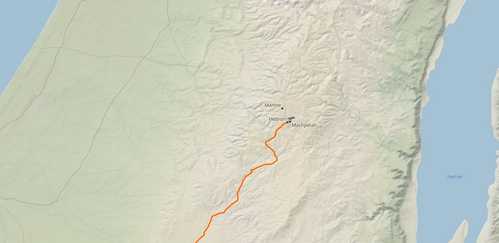
The cave is in the field of Makpelah, near Mamre, which is Hebron. And that location carries a whole history. When Avraham finally settled into his most permanent camp, it was by the oaks of Mamre. He pitched his tent there, built an altar there, and Yahweh appeared to him there. A tent, a tree, an altar, and God showing up — that's temple imagery. That's Eden imagery.
It's also where Avraham was sitting when the coalition of kings was ransacking the region — he's just having lunch with his covenant friends by the tree. It's a refuge. And it's where the three men appeared to him, where he sat at the door of the tent and ate with Yahweh under the tree. It's where Yahweh promised that Sarah would have a son within the year.
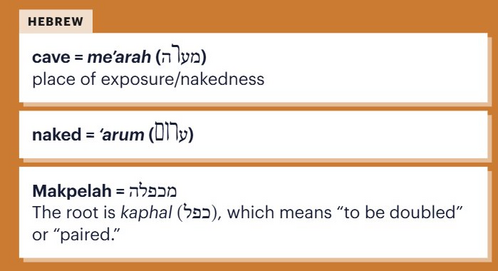
Now look at the names. Makpelah means a couple, or a pair. And the word for cave is built from the same root as nakedness — to expose, to uncover. So by the oaks of Mamre sits an enclosure called, quite literally, the "Nakedness of the Couple."
Think about what that means. A garden with a tree, a tent, an altar, a meal shared with God — you're standing in Eden. But it's also the place where the couple's nakedness was exposed, which was the sign of their loss of access to eternal life. And that's the name of the cave where Sarah is buried. Where Avraham is buried. Where Yitskhaq and Rivqah are buried. Where Leah is buried. Where Yaaqov wants to be buried.
This is all built into Genesis 23, and Yaaqov's request assumes you know it.
"Gathered to His People"
Notice the phrase Yaaqov uses. "I am about to be gathered to my people." That's not common language. It's what Avraham says when he dies. It's what Yitskhaq says when he dies. And now it's here with Yaaqov.
His people are somewhere, and he's going to go be with them.
So what did Yaaqov actually believe about the afterlife? That's an interesting question, and there are scholars who dig into ancient Israelite tombs trying to answer it. But that's not quite the question we're asking. We're asking what the people who shaped this text, in light of the whole Hebrew Bible, want us to hear. And what they want us to hear is a patriarch saying: I'm going to go be with my ancestors in Eden.
It's a tragic picture in one sense. There's more that God wants for His world and for these people, and for now it's a return to the dust. But it's a hopeful return to the dust, because the return to Eden is about the hope of restored eternal life.
Jumping to Jesus
Now watch where this thread goes.
In Luke 23, Jesus is crucified between two criminals. One of them mocks Him. The other rebukes the first one and says, "We're getting what we deserve. This man has done nothing wrong." Then he says, "Jesus, remember me when You come in Your kingdom."
And Jesus answers: "Truly I say to you, today you shall be with Me in Paradise."
That word is paradeisos. It's a transliteration, not really a translation. And it shows up three times in the New Testament. Paul uses it in 2 Corinthians 12:4, describing a vision where he was caught up into paradise and heard inexpressible words. Revelation 2:7 uses it as a promise from the risen Jesus: to the one who conquers, He will give the right to eat from the tree of life, which is in the paradise of God.
But here's the thing. If you search for that word in the Greek translation of the Old Testament, the Septuagint, you find that paradise is the translation of the word garden. Genesis 2:8 — "The Lord God planted a paradise in Eden toward the east, and there He placed the human that He formed."
So what Jesus is really saying to that criminal is: Today, I'll meet you in Eden. In a few hours, we'll reconvene in Eden. We will be gathered to our people.
Abraham's Side
There's another thread worth pulling. In Luke 16, the poor man dies and is carried by the angels to Abraham's side. Where's Abraham? He's buried in the cave.
He's in paradise.
That image of resting at Abraham's side is almost certainly connected to this whole network of ideas. It represents someone who understands what the cave of Makpelah means. If you belong to the covenant family, then when you die, your life is held safe in paradise.
Which raises a fun question. When Jesus says, "Today you'll be with Me in paradise," but three days later He's showing up with His friends — where is He? Or when Paul can say he was praying in his living room one minute and caught up into paradise the next? What we're talking about is where heaven and earth meet. Another dimension, woven right alongside this one.
Where the Whole Story Lands
And then Revelation 21 and 22 bring it home. John sees a new sky and a new land, and a holy city coming down out of the sky, made ready like a bride for her husband. It's the temple. It's God dwelling with His people. Heaven coming fully to earth.
And inside that city? A river, clear as crystal, flowing from the throne. And the tree of life on each side of the river, bearing twelve kinds of fruit, producing fruit every month, with leaves for the healing of the nations. And no longer any curse.
Eden imagery, start to finish. Outside the garden, then inside, then the city and its dimensions, then the river, then the tree, then no more curse.
So here's what we're holding together. Eden is the primary image for the reality you enter when you die to this age. But it's also temporary, because the ultimate goal is for heaven to rejoin completely with earth and transform material reality. Jesus says, "Today you'll be with Me in paradise," and the final conclusion of the biblical story is paradise remaking the material universe as we know it.
It's both. And notice — heaven isn't the primary image. The garden is. Being gathered to your people is.
I don't have any hope that the word "heaven" is getting dislodged from our vocabulary anytime soon. Going to heaven when you die. But what it means is going to Eden to be with God's people until heaven meets earth one day. That's the imagery here.
When this dusty form of ours gives out, there's a part of our human identity that God can sustain and apparently will sustain in the garden until we're all reborn along with the universe. It's less about humans being inherently immortal and more about God having a dream for a reborn cosmos — and Him holding His beloved ones in existence so they can participate in it.
And the holding place is called Eden. Or the garden. Or the cave. Or paradise.
One Question to Take Home
So here's what I'd leave you with this week.
Yaaqov spent his last breath making sure his body would rest in the one patch of ground that pointed to the promise. He wasn't obsessed with real estate. He was declaring, with his dying words, that he believed God's story ended in Eden and not in Egypt.
If your last request had to say out loud what you actually believe about where this is all going — what would it say?